Chris Vos on the work that keeps The Record Company going.
Before The Record Company played Boarding House Park, I asked Chris Vos what he was most proud of. I thought he’d probably go straight to a record or maybe some show that still hangs around in his head. They’ve been doing this long enough that there had to be a few things to choose from. Vos didn’t pick any of them.
“I’m proud of the whole journey, because the whole journey is what it takes,” Vos said. “Including this moment right now, answering this question.”
I laughed at that last part. I hadn’t really considered sending him a list of questions as part of The Record Company story, but Vos apparently did. He wasn’t only counting the big stuff when he looked back. Answering some questions on whatever day he happened to sit down and do it counted too.
“To get to the point where somebody asks you a question like that, you’ve had to make a lot of steps,” he said. “You’ve had to learn a lot of lessons and rise to a lot of challenges. You have to compromise. You have to put quality into everything you do, and that means keeping your eye on the ball.”

Vos used baseball to explain the rest. “You can’t celebrate a home run if you ain’t thinking about hitting the ball first. Hit the ball, then go. That’s been my philosophy since day one. Do one thing at a time, as good as you possibly can, then do the next thing.”
He applies the same thinking to music. Play one note and worry about the next one when you get there. The same goes for a show or making a record. After enough of them, you can look back and see where all of it took you.
The Record Company is five albums in now, so I was curious if success still meant what it did when they made the first one. Vos said that early on they were trying to find out if this could actually be their life. By the fifth record, they know a lot more about what they’re getting themselves into.
“I think the difference between this album and the first one is that on album one, you’re trying to establish that the thing you love to do can pay the bills and sustain you,” Vos said. “By album five, you’re asking yourself the same question. Can I keep things going? Can we do this at a high quality?”
The difference now is that there’s room for some other questions.

“By album five, you’ve got a good look at what it’s all about, and that’s when you can ask the deeper questions,” he said. “What do I love about doing this now? What’s the next thing I want to say?”
When I asked what success means to him today, his answer was pretty simple. “Success is waking up every morning and knowing there’s love around you, that you love what you do, and that you’ve had a part to play in that.”
I didn’t know Vos grew up on a small farm in Wisconsin until it came up in one of his answers. His parents still run it. I had asked how The Record Company has managed to change over the years without doing it just because enough time had passed and they felt like they should sound different.
“I don’t think we’ve ever changed for the sake of change,” he said. “Growing happens naturally when you tend to the things that matter. I learned that being the son of a farmer.”
Vos learned how to communicate there too. That part has followed him into The Record Company in a pretty direct way.
“When you see each other and you listen to each other, on stage and off, and I’ll say that again, listen to each other, on stage and off, communication stays clean,” he said. “Understanding increases. Growth happens.”

If one of them starts pulling the music somewhere different, Vos doesn’t see that as something the other two need to shut down.
“When somebody else is feeling a change, instead of being afraid of it, you’ve got to be curious, support it, and see where it leads,” he said.
That gets harder when you’ve known each other as long as these three.
“You have to see each other. You have to realize you’re a chosen family. But as everyone knows, families can be complicated, and I think that’s important to remember.”
I wasn’t looking for the details of whatever those complications have been. Every band that’s been around for a while has them. Vos was more interested in what keeps those things from becoming bigger than the reason everybody is there in the first place.
“At the core of it, when it’s done right, families, bands, and chosen families are all built on love, a deep love,” he said. “If there’s love there, then there’s going to be understanding, and there’s going to be support.”
He finished that answer with something I probably wouldn’t have expected at the beginning of our exchange.
“To put it bluntly, I love it all, because all of it brings with it a great lesson.”

You don’t have to spend much time with a Record Company record before the blues and rock stuff starts showing itself. Vos isn’t running from any of that. I asked him how you take something you’ve listened to forever and make it yours without just copying the people who taught you.
He started talking about learning to fish.
“What matters is that you don’t pretend you’re time traveling,” Vos said. “Everything that inspires you happened in the past, whether it was a couple days ago or ninety years ago at the beginning of recorded music. Either way, you’re expressing it now.”
That one stuck with me. There’s no reason for The Record Company to pretend those old records aren’t in there. The interesting part is what happens to them once they’ve gone through three other people.
“So you take everything you know and ask yourself in that moment, what do I have to say now?” Vos said.
Vos remembers making that first record in a living room with what he called “a really shoddy pile of gear.” The setup isn’t so shitty anymore, and I don’t think he misses that part of it. He still likes doing things the old way. He just has better stuff to do it with now. None of that decides whether the song is any good.
“The target never moves,” Vos said. “It’s to ask yourself, is this something I truly believe in? And when the answer is yes, and the sound of it excites you, it’s always exciting. That will never change.”
I asked Vos about audiences too. After playing as many places as The Record Company has, I thought there might be certain towns or crowds he could read before a show even started. He said he’s learned not to do that.

“I’ve learned never to define a town or an audience before it has defined itself,” he said. “You never know which song is going to flip the switch on any given night. You never know which town’s going to scream the loudest.”
I’ve been wrong about a crowd plenty of times. I’ve gone into shows expecting the place to be nuts and it wasn’t. I’ve also walked into rooms expecting absolutely nothing and ended up having a great night. Vos has seen the much shittier version of that. Sometimes hardly anybody shows up.
“The people out in the audience, the people who listen to the music, they’re the ones giving the gift to us, the artists,” he said. “No people in the room, I’ve done that. It’s not fun. It doesn’t feel good.”
That isn’t something I normally think about when I walk into a show. I’m thinking about the band, who I’m there to see, whether they’re any good that night. I’m definitely not thinking of myself as the one bringing the gift.
“All you can do as a performer is get up there and play every show like it’s one less time you’re going to play in your life, not one more,” he said. “Give it everything you have, every time, from the heart.”

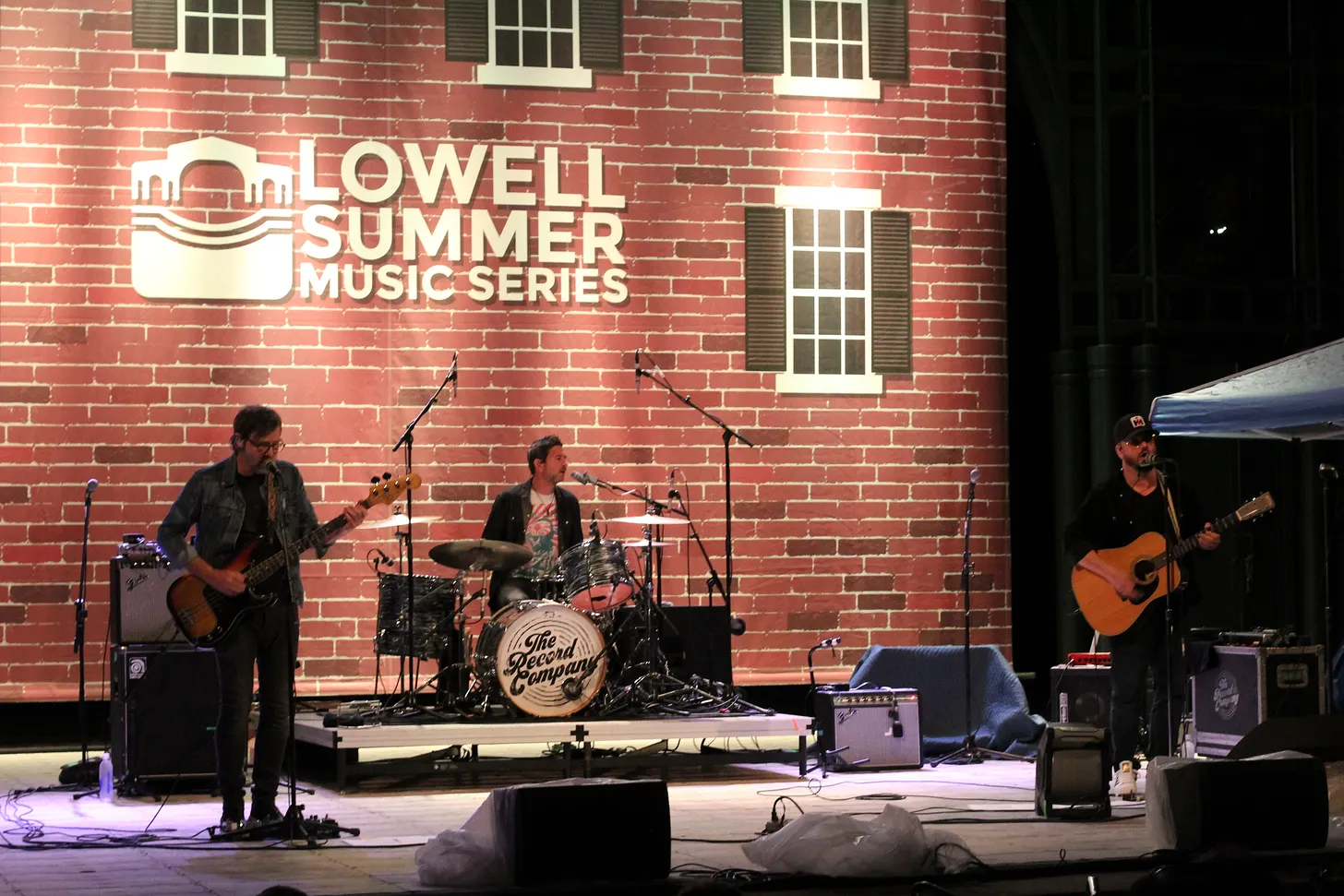
By the time The Record Company got onstage at Boarding House Park, the weather wasn’t doing anybody any favors. I had the camera with me and once the rain picked up, that became most of what I was thinking about. I wasn’t writing much down.
Maybe that’s fine. I’d already asked Vos what I really wanted to know about seeing them play.
“What I hope people walk away with is the reality of what they saw,” he said. “If we did our jobs, they’re going to see three guys who love what they do, who play rock and roll music, heavy on the roll, and put on a show with everything they’ve got.”
I like “heavy on the roll.” That sounds like them.
Vos went on to talk about everything that can happen once a band gets onstage.
“That’s the only thing we can control as a band, how we bring it to the people,” he said. “Things break, equipment melts down, it rains, the sun shines. Any which way you slice it, if you’re on stage, that’s your opportunity to do the best you can.”
I had his answers well before the show, so I had to laugh when I went back and read that part. He could’ve picked just about anything that goes wrong at a show. He picked rain.
Of course he did.
I didn’t take many notes that night. I got some pictures, watched the band and spent a stupid amount of time worrying about whether my camera was getting wet. The Record Company had their own shit to worry about.
Once they started playing, none of it seemed to matter much.
Leave a Reply