His guitar, his keyboard and an audience hanging on every song
During “Plain Jane Heroin,” I noticed the room getting quieter until the people singing near me were barely above a whisper. A few minutes earlier it felt like half of Brighton Music Hall was singing with Theo Katzman. This happened throughout the night. I watched it happen a few times after that. The crowd would be singing with him, sometimes pretty loudly, and then suddenly I could hear the people closest to me again. Katzman had mentioned that exact thing when we talked over Zoom a few days earlier.
“The audiences are very, very, very attentive and very open to my performance,” he said. “It feels like the engagement is like 100%, you know?”
I figured I’d find out for myself soon enough. Artists talk about crowds all the time. A few nights later I was standing in the middle of this one.

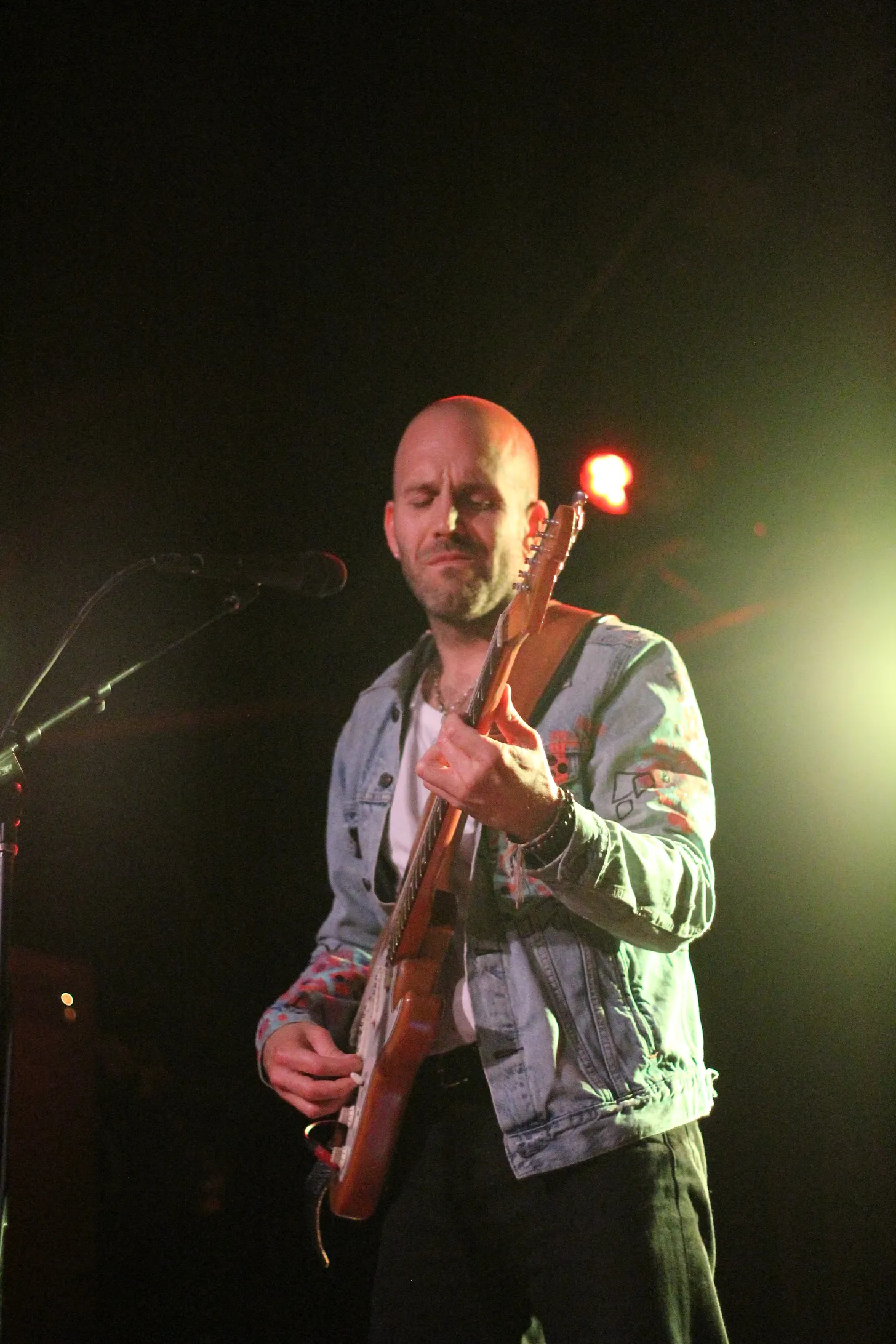
Brighton was packed. Looking around the room, there didn’t seem to be much of an age requirement for being a Theo Katzman fan. Katzman spent most of the night switching between guitar and keyboard. The sound was great from where I was standing, especially his voice. What I kept noticing though was how much the crowd was paying attention. He had described the audiences on this run as being “pretty pin-drop silent and also full, full sing-along.” Now I knew what he meant.
I had never seen Katzman before, which is strange considering how long I’ve listened to Vulfpeck. It wasn’t for lack of trying. I missed him around the Be the Wheel run when something came up at the last minute and apparently held onto that disappointment long enough to complain about it directly to Katzman years later. Thankfully he didn’t hold it against me. At least I finally stopped missing him.
Most of the rooms on this tour hold around 300 to 500 people, which Katzman told me is right about where he likes them. There’s no opener. Once he walks out, he has the room for the night.
“I do love doing big shows with a band,” he said, “but this is something I’ve always wanted to do, is just get to play smaller rooms with just like a living room vibe, you know?”

That sounded interesting to me because Katzman’s music can get pretty layered. I went into the interview thinking about the full-band versions and wondering how much work it took to strip them back down. Turns out I had the order wrong.
“All the songs start on an instrument, with me singing them by myself before I arrange them for the band,” he said. “So in a way, it’s like the solo arrangements were already there.”
“I just had to kind of like remember what the original seeds were, and then I was like, oh yeah, this is the whole song.”
I thought about that during the show because I had gone in assuming I was going to hear smaller versions of Katzman’s songs. I was thinking about the records. Katzman was thinking about where the songs started.
Some of them have changed quite a bit since then. Katzman said there are songs that go “way, way more into a rock zone” with the band, especially once everybody starts stretching things out. Some of that still makes it into the solo show.
“I love to sing guitar parts,” he said.
“We’re not going to extend the song by like four minutes of solos,” he said.
That gives him more time for songs, which isn’t exactly a problem at this point. He has been making his own records throughout his years with Vulfpeck and producing other artists became part of his work along the way. None of that is going anywhere. Right now he wanted some time with his own songs.

“I just felt a call to focus on the original vision,” Katzman said, “which was to do this, just share my songs from my heart and kind of that rock and roll inspired music.”
Turning 40 had something to do with the timing too.
“It was like time to focus on this, you know?” he said. “And I will come back to all the projects in the future, but I just wanted to focus on this during this chapter, this next chapter.”
The show also gives him some freedom to reach further back. There are songs Katzman knows people want to hear and newer ones he wants to play. The rest can move around a little depending on the night.
That happened at one of the shows before our interview when somebody yelled out “Brooklyn.” Katzman told me he couldn’t remember the last time he had played it.
“I haven’t played in probably, I don’t know how many years, 10 years,” he said.
He decided to try it, and apparently he was glad he did. “It felt amazing. It was really fun.”
A few shows later he was already thinking about playing it again. I liked that. Somebody yelled out a song Katzman hadn’t played in about a decade, and he played it anyway. Now it might stick around.
The crowd at Brighton seemed to understand the deal. They sang a lot and got quiet when Katzman did. Nobody seemed too interested in making themselves part of the show.
After playing two ballads back to back, he told Boston they had been so great that everybody earned the reward and punishment of getting two ballads in a row.
Humor had already come up when we talked because it shows up all over Katzman’s writing, including in songs where whatever is underneath the joke can get pretty heavy.
“I love humor, and I find that humor is often accessible in times of hardship,” he said.
He also knows being funny can be a pretty good way to avoid something.

“I try to like find that edge in general in life where something that’s difficult to deal with, there’s also a lightness to it,” Katzman said. “Sometimes like finding a little bit of humor can allow people to relax, and then they can go a little deeper into what the song is tackling.”
That was easy to hear at Brighton. One minute the room would laugh and a few lines later nobody was making a sound. Katzman never seemed uncomfortable with either reaction. If the room got quiet, he left it quiet.
The recent acoustic version of “Lisa Never Wanted to Be Famous” came up during our conversation. Katzman originally wrote the song on guitar and sent a voice memo to Cory Wong, who came back with an arrangement that added strings and horns. Katzman loved it enough that they went into the studio and recorded it, but Wong also told him there was something about that original voice memo worth keeping and encouraged him to release that version too.
Katzman eventually came back around to the idea, although he didn’t use the original recording. It was literally his first performance of the song, and by the time he revisited it he felt better about where his voice was and wanted to record it again. He used a Tascam cassette four-track, one of the first recording devices he ever got into.
“It just all kind of felt like this return, you know, back to the beginning,” Katzman said. “In a new way.”
I started thinking about how often some version of that had come up while we were talking. The solo arrangements were already there before the full-band versions. The Tascam went back to when Katzman was first getting into recording. “Brooklyn” showed up again because somebody yelled for it after about 10 years. Now he was spending a tour playing his own songs in small rooms again. There was a lot of looking backward for somebody who kept talking about what he wanted to do next.
His writing, meanwhile, is changing.
“I think it’s changing in real time for me,” he said.
Katzman told me he has collected a lot of material over the last couple of years, but some of the ways he used to write don’t feel like they are working anymore. He has been experimenting and trying to figure out what makes a song resonate with him now, which got us talking about his label, 10 Good Songs, and what he means by “good” in the first place.
“It’s easy for the word ‘good’ to be a judgment,” he said.
The name makes it sound like there should be some test a song has to pass. Katzman doesn’t really look at it that way.
“It’s more like, is it honest, and does it really have a resonance within you as you’re creating it?” he said. “Because if it has a resonance within you, then it will resonate with others. And I think that’s really what we’re looking for.”
He joked about the other side of that too. A song can reach a ton of people and somebody can still listen to it and get nothing from it. Katzman knows that world pretty well from his time at the University of Michigan School of Music.
“I was not a great student in music school, I have to say,” he said.
He wasn’t blaming the school. “The professors definitely knew what they were talking about in terms of the music education that they provided.”

Katzman was busy doing his own thing. He was making original music with his friends, playing in bands and trying to get out on the road. Looking back, he can see resources he probably could have used better.
“I can see now how I could have utilized the resources available to me much better,” he said. “But it’s like they say, youth is wasted on the young, you know?”
The touring part was something Katzman and his friends ended up learning by doing it.
“We basically tried to get on the road as soon as we could,” Katzman said. “The professors really didn’t know anything about that, or have much to say about what it looks like to be a touring act in the mid-2000s. Like I could write a book on that now, you know, but nobody had that book then.”
Some of that you only learn by doing it. Katzman and his friends wanted to tour, so they went.
“You’re bathing in that water,” Katzman said. “That’s what you’re trying to figure out.”
Katzman has been in it long enough to have seen several versions of the music business by now. He started trying to get bands on the road in the mid-2000s and has since played tiny rooms and sung in front of tens of thousands of people. He has his own label and produces records for other artists. After everything that has happened, I liked that he could still talk about parts of it like somebody who was trying to figure them out as he went.
There is more he wants to figure out creatively too. When I asked whether there was anything at this point in his career that still felt unfinished, Katzman didn’t get very specific.
“There’s a lot in the works right now,” he said. “There’s a lot of exploration going on. So I’m excited for the next chapter.”
He journals quite a bit and reads a lot, but most of his writing still ends up in songs. Katzman said he has never really written poetry on its own beyond maybe once or twice. There has been some prose, just not enough for what he joked would be a “prose channel.”

“I don’t know if I have a novel in me,” he said.
Songs are still where most of it goes. At Brighton, I got to hear a few hundred people sing them back to him.
I wrote something in my notes during the show that I kept coming back to later: Gives me hope for live music.
Katzman has played in front of 50,000 people with Vulfpeck. This night was a few hundred people in Brighton, close enough that he could hear somebody yell a song from the crowd.
When I asked what he hoped somebody unfamiliar with his catalog would get from a Theo Katzman show, he didn’t make it complicated.
“I think they will see a very connected audience and performer situation,” he said.
“I know what it feels like to sing to a stadium, and I know what it feels like to sing to a small club,” Katzman said. “So I try to bring the club into the seat of the stadium, and I try to bring the stadium to the club.”
By the encore, Brighton had been with him all night. Katzman came back out and started the first song away from the microphone with the crowd singing along. After listening to them sing with him for most of the night, it didn’t feel like much of a risk.
Leave a Reply